
 blog
blog
Digital K9 Management Tools for Police
Table of Contents
- Why Digital K9 Management Tools Matter for Police Departments
- Police K9 Record Keeping Requirements and Legal Standards
- Core Features of Effective K9 Management Software
- K9 Training Log Templates and Standardization
- K9 Certification Management Tools and Compliance
- Transitioning from Paper Records to Digital Systems
- Court-Ready Documentation and Liability Defense
- Frequently Asked Questions
Last Updated: September 14, 2026
Why Digital K9 Management Tools Matter for Police Departments
Police K9 units face a critical challenge: maintaining court-defensible records across training, deployments, certifications, and health documentation. Digital K9 management tools centralize this information, which would otherwise scatter across paper logs, spreadsheets, and fragmented systems. Courts demand documentation that's complete, timestamped, and consistent, something paper-based records rarely survive legal scrutiny.
The gap between "organized enough for us" and "defensible in court" is often larger than departments expect. A handler's notebook and spreadsheet work for daily use, but neither produces the structured, auditable records prosecutors need when a K9's work becomes evidence. Purpose-built digital K9 management tools close that gap.
Police K9 Record Keeping Requirements and Legal Standards
Police K9 records are evidence, not just operational logs. When a K9 alerts, searches, or participates in an arrest, its training history, certification status, and deployment context become part of the case file. Courts scrutinize handler qualifications, training recency, and whether the K9 worked within its certified capabilities.
Most departments maintain records because it's required, but don't structure them for legal defensibility. A handler's notebook won't survive cross-examination about training dates or certification scope. Digital systems create an auditable trail showing when records were entered, by whom, and whether they've been modified, critical when a defense attorney challenges the K9's reliability.
Police K9 record keeping requirements vary by jurisdiction but commonly include initial training, ongoing certification, handler qualifications, and deployment outcomes. Many agencies follow NFSTC (National Forensic Science Technology Center) guidelines or state law enforcement training standards. Your records must demonstrate that the K9 was trained, certified, and deployed appropriately, digital systems make this demonstrable in ways paper cannot.
Core Features of Effective K9 Management Software
Purpose-built K9 management software combines deployment tracking, training documentation, health management, and certification oversight in a single interface. This integration matters because deployment suitability depends on recent training, current certifications, health status, and handler availability.
Deployment and Incident Logging
Deployment records form the backbone of K9 operational history. Every deployment, building search, narcotics detection, tracking, needs documentation including date, time, location, handler, task, outcome, and alerts. Digital systems timestamp entries automatically and prevent backdating, crucial for legal defensibility.
Incident logging captures context when a K9 alerts, bites, or is involved in a use-of-force situation: what the K9 was trained to do, whether the alert was consistent with training, the handler's response, and the outcome. This detail protects both handler and department when incidents are reviewed in court.
Training Documentation and Performance Tracking
Training records should include date, handler, training type, duration, environment, and results. Over time, these records reveal patterns: whether performance is consistent, improving, needs remedial work, or indicates approaching retirement.
Performance metrics inform deployment decisions. A K9 with declining agility performance might need conditioning before high-impact work. Digital systems make this data visible at a glance for handlers and supervisors.
Health and Medical Record Management
K9 health documentation includes vaccinations, veterinary visits, injuries, medications, and conditions affecting deployment suitability. Digital health records ensure handlers and supervisors can verify the K9 is physically ready before deployment.
K9 Training Log Templates and Standardization
Consistency in training documentation is critical. Different handlers recording the same training differently makes it difficult to assess performance or defend training in court.
Standardized training log templates require consistent data entry: date, handler, K9 ID, training type, duration, environment, objectives, and results. Templates ensure critical details aren't forgotten.
Digital systems enforce standardization through dropdown menus, mandatory fields, and consistent formatting. This allows you to pull all "narcotics detection" training from the past year and analyze performance trends, impossible with paper logs.
K9 Certification Management Tools and Compliance
K9 certifications are time-bound and vary by discipline. Supervisors must track expiration dates and ensure no K9 is deployed for tasks it's not currently certified to perform.
Manual certification tracking is error-prone. Digital certification management systems send alerts when certifications approach expiration, maintain clear records of scope and validity, and prevent deployment of uncertified K9s.
Digital systems enable compliance reporting: audits can generate reports showing every K9's current certifications, expirations, and upcoming renewals, demonstrating active management and policy compliance.
Transitioning from Paper Records to Digital Systems
Moving from paper logs to digital systems is a common challenge. The biggest mistake is underestimating scope or trying to digitize everything at once while maintaining operations.
Audit and Inventory Your Current Records
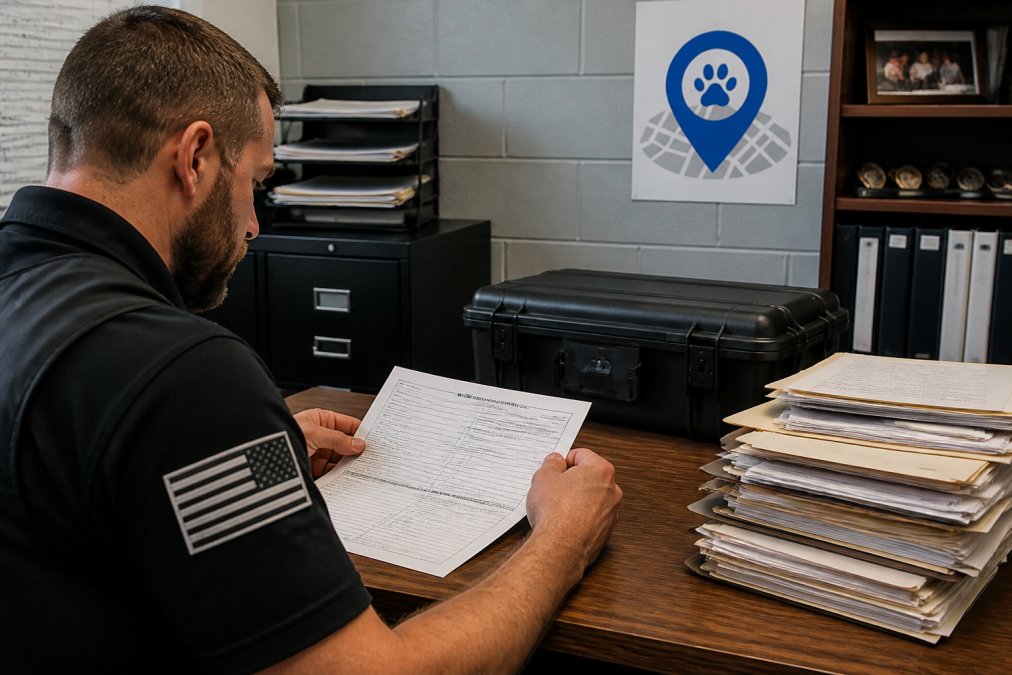
Before selecting a digital system, audit where records currently live. Most departments find K9 records fragmented across handler notebooks, lockers, veterinary files, HR, incident reports, and dispatch systems.
For each record category (training, deployment, certification, health), identify where it's stored, who maintains it, retention period, and accessibility to handlers and supervisors.
Document the volume of historical records. A five-dog unit with five years of history might have 500-1,000 training records; a 20-dog unit with ten years could have 5,000+. This volume affects timeline and resources.
Establish Data Standards Before Digitization Begins
Define your data structure before entering records into the new system. This prevents inconsistent entry, which defeats digitization's purpose.
Standardize key fields:
- Training records: Date, handler, K9 ID, training type, duration, location/environment, objectives, results, and observations.
- Deployment records: Date, time, K9 ID, handler, deployment type, location, task, outcome, and incidents.
- Certifications: Type, issuing authority, issue date, expiration date, scope, and renewal requirements.
- Health records: Date, entry type, details, veterinarian, and deployment restrictions.
Establish consistent date formats, K9 ID naming conventions, and training type categories. This enables queries like pulling all narcotics detection training from the past 12 months to analyze trends.
Plan Your Digitization Workflow
Choose one of three approaches:
Parallel Operation (Recommended): Begin entering new records immediately while digitizing historical records gradually. Most departments digitize 50-100 records per week with one part-time person. A 1,000-record unit completes in 10-20 weeks. Handlers use the system immediately, though complete historical records aren't available initially.
Bulk Digitization: Best for small units or recent records only. Complete digitization before go-live, giving a complete archive from day one, but delays system launch.
Hybrid Approach: Digitize deployments and certifications first (most legally critical), then training and health records. Enables reporting and compliance checks while completing the archive.
Address Handler Adoption and Training
Frame the transition around handler benefits: easier access to K9 history, automatic certification alerts, and records that protect them if incidents are questioned. Show how the system reduces time spent searching for information. Provide hands-on training before go-live, walking handlers through entering records and viewing certification status.
Manage the Compliance and Audit Trail
Establish clear policies for editing records: Can handlers edit entries after submission, or does supervisor approval apply? How are errors in historical records corrected and documented? Digital systems log all changes, creating an audit trail, but your policy must clarify correction procedures. Verify data integrity during import by spot-checking samples against originals.
Timeline and Resource Planning
A realistic timeline for a medium-sized unit (8-12 dogs, 3-5 years of records):
- Weeks 1-2: Audit records, define standards, select system
- Weeks 3-4: Set up system, configure fields, train handlers
- Week 5 onward: Enter new records; digitize historical records in parallel
- Weeks 12-16: Complete digitization; full system operational
Smaller units compress this; larger units extend it. Prioritize careful transition over speed for better data quality and adoption.
Court-Ready Documentation and Liability Defense
K9 record-keeping must hold up in court and meet compliance standards. Prosecutors must prove the K9 was trained, certified, and deployed appropriately. Defense attorneys seek gaps or inconsistencies that undermine reliability.
Legal Standards and Compliance Requirements
National Forensic Science Technology Center (NFSTC) Standards
State Law Enforcement Training Standards
CJIS Compliance and Data Security
Integration with Agency Infrastructure
Computer-Aided Dispatch (CAD) Integration
Incident Report and Evidence Management Systems
Building a Court-Ready Record
Liability Defense Beyond Criminal Cases
Frequently Asked Questions
Why is digital record keeping critical for police K9 units?
Digital K9 management tools create a centralized, searchable record of every training session, deployment, and certification. This documentation protects departments in litigation by providing court-admissible evidence of proper handler training, K9 conditioning, and operational standards. Paper records are easily lost, difficult to audit, and carry higher liability risk. Digital systems ensure compliance with law enforcement documentation standards and make performance metrics instantly available for agency oversight.
What should a K9 training log template include?
Effective K9 training log templates must capture handler name, K9 identification, date, duration, exercise type, performance notes, and any health observations. Templates should enforce consistency across all handlers so records are comparable during audits or legal review. Standardized fields for bite sleeve work, detection training, obedience, and handler conditioning ensure nothing is overlooked. Many departments benefit from templates that align with ANSI 076 standards for certification tracking and court-ready reporting.
How do digital K9 certification management tools help with legal compliance?
K9 certification management tools track renewal dates, training hours, and competency assessments automatically. They generate alerts before certifications expire and produce reports that demonstrate ongoing compliance with professional standards. When a case goes to court, these tools provide timestamped proof that handlers and K9s met all required training and certification benchmarks at the time of deployment. This documentation significantly reduces liability exposure and strengthens the defensibility of operational decisions.
What's the difference between spreadsheets and dedicated K9 management software?
Spreadsheets lack audit trails, are prone to human error, and cannot generate court-ready reports automatically. Dedicated digital K9 management tools enforce data consistency, create searchable archives, track changes with timestamps, and produce formatted reports suitable for legal proceedings. They also handle deployment logging, health records, and equipment inventory in one system. For departments managing multiple handlers and K9s, dedicated software eliminates the manual work of maintaining separate files and reduces the risk of lost or incomplete documentation.