
 ultimate-guide
ANSI 076 Compliance for K9 Units: 2026 Guide
Table of Contents
- What ANSI/ASB Standard 076 Actually Requires of Your K9 Unit
- Standardized Training Protocols and Certification Requirements Under ANSI 076
- The Benefits of Cloud Based K9 Record Keeping for Compliance
- Building Defensible K9 Training Logs: Documentation and Record Keeping
- K9 Unit Certification Tracking and In-Service Training Frequency
- Deployment Procedures, Handler Evaluation, and ICS Integration
- Gap Analysis: Old Practices vs. ANSI 076 Standards
- Frequently Asked Questions
Last Updated: September 14, 2026
What ANSI/ASB Standard 076 Actually Requires of Your K9 Unit
ANSI/ASB Standard 076 is the consensus-based standard for canine detection teams, setting minimum requirements for training, certification, and documentation across scent-detection disciplines including human remains detection and explosive detection. This guide from Trakker breaks down what the standard asks of your unit and how to demonstrate compliance without rebuilding your program.
Courts and agencies increasingly ask whether a canine team's work rests on recognized best practices. A handler who can produce structured training logs, current certification records, and documented deployment protocols answers that question before it's asked.
Below, we cover the technical requirements, the documentation that proves them, and the implementation roadmap, the areas auditors and opposing counsel actually probe.
Standardized Training Protocols and Certification Requirements Under ANSI 076
Standard 076 requires every canine team to train against a written protocol, not an informal routine. The standard sets technical requirements for odor recognition, search patterns, and proficiency testing that handlers must document at defined intervals. A protocol that lives in a sergeant's head does not satisfy the standard, it cannot be audited, taught to a new handler, or read into a hearing record.
A compliant protocol addresses five things: the target odors the team is certified on, the source materials and quantities used, the search environments the team works (buildings, vehicles, open terrain, water edge), the proficiency thresholds the team must hit, and the re-test interval. Silence on any of those five is the gap an auditor finds first.
What the proficiency testing actually looks like
Certification under the standard is not a one-time event. It involves an initial examination, periodic proficiency testing, and in-service training that keeps detection accuracy current. Handler and canine certifications are tracked separately, because either can lapse independently, a certified dog with a lapsed handler is not a compliant team, and vice versa.
The mechanics most units under-document:
- Odor recognition testing. The team must identify the target odor before searching for it, usually run as a lineup of samples, some containing the target odor, some not, with the team required to indicate on the target and ignore the blanks.
- Blind and double-blind hides. In a single-blind problem, the handler does not know the hide location but the evaluator does. In a double-blind problem, neither the handler nor the person running the search knows, a third party places the hide. Double-blind problems carry the most weight in court because they remove the possibility that the handler cued the dog.
- Blank runs. A search area with no target odor at all. A team that alerts on a blank run has a false-alert problem no amount of successful finds will paper over. Blank runs are the most common omission in unit training files.
- Distraction and contamination controls. Distractor odors, food, animal remains, and previously used search areas belong in the record, as does not reusing a hide location within a training cycle, which prevents the dog from learning the place instead of the odor.
Initial certification versus recertification
The initial certification examination establishes baseline competency for a new team; recertification is the recurring proof the team still has it. The standard expects ongoing validation between those events, and a lapsed record is a gap in your compliance story regardless of recent field performance.
A practical pattern is to treat annual recertification as the anchor and build quarterly proficiency problems around it, so the team is never more than a few months from a documented, evaluated search, and a failed problem surfaces in a training file rather than a case file.
Where the standard stops and your policy begins
Standard 076 sets minimums, not maximums. It does not dictate which odors your unit certifies on, how many hides constitute a passing problem, or how long a search area should be, those are decisions your agency makes and writes down. The compliance question is whether your protocol states your numbers, your training records show you hit them, and your certification records show the team is current.
The Benefits of Cloud Based K9 Record Keeping for Compliance
Cloud based K9 record keeping puts training logs, certification files, and deployment records in one searchable location instead of scattered binders and spreadsheets. For compliance work, the benefit is speed: a team's complete history pulls in minutes rather than days.
The bigger advantage is consistency. When every handler logs training in the same structured format, gaps become visible before they become problems, and supervisors can audit in-service training frequency across the unit without chasing paperwork.
Trakker was built for exactly this: a centralized system for police and working-dog teams that tracks training, deployments, and certifications together and produces court-ready reports when a case demands them. ANSI 076 standards are built into the platform, so compliance status stays visible rather than buried in a file cabinet.
Building Defensible K9 Training Logs: Documentation and Record Keeping
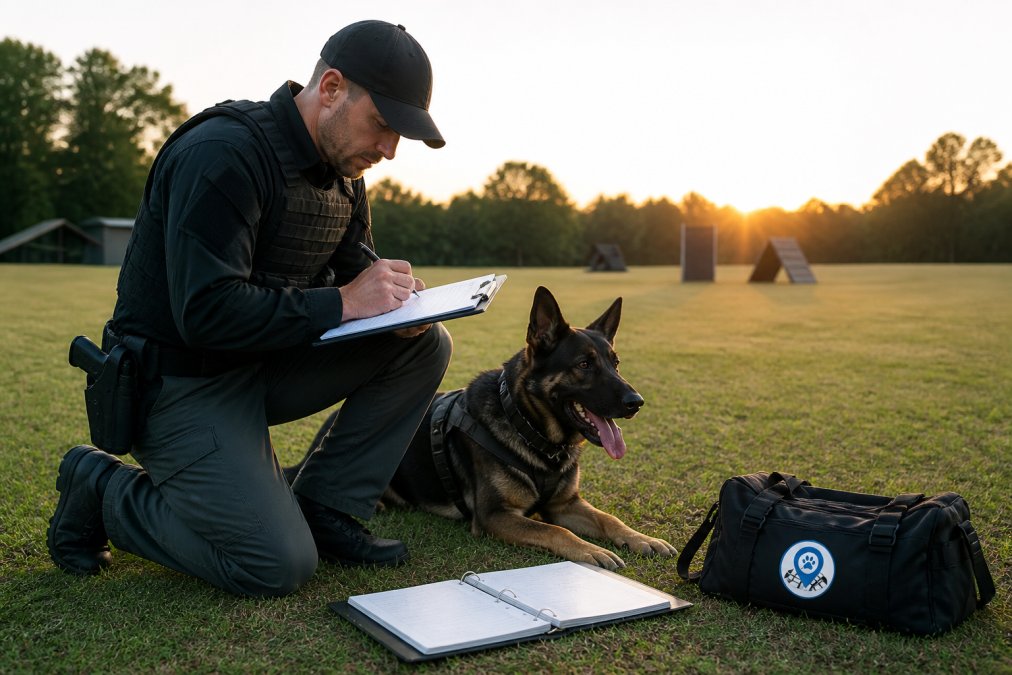
A defensible K9 training log records what was trained, when, where, by whom, and with what result, and should stand on its own if read aloud in a hearing without the handler present.
The elements that make a log defensible are consistent across agencies:
- Date, time, and location of each training session
- Odor type and source used, with quantity noted
- Search area description and environmental conditions
- Handler and canine identification
- Outcome, including false alerts and misses
- Signature or verification by a supervisor or trainer
What most guides miss is the false-alert entry. A log that records only successes reads as incomplete to anyone who understands detection work. Documenting misses and how the team corrected them is what makes the record credible. According to the ANSI/ASB standards program, consensus-based standards exist precisely so that documentation reflects real performance, not a highlight reel.
K9 Unit Certification Tracking and In-Service Training Frequency
K9 unit certification tracking means maintaining a live record of every team's certification status, expiration date, and renewal history in one place. Without it, a unit commander is guessing about who is current.
In-service training frequency is where most units drift. The standard expects regular, documented training between certifications, with the interval defined in your written protocol. Tracking it lets you show a continuous training record rather than isolated certification dates with empty months between them.
A practical approach: set a fixed in-service cadence, log every session against it, and review compliance status monthly. Trakker's certification tracking keeps expiration dates and training history in one view, so supervisors see who is due for renewal before it becomes urgent.
| Record Type | What It Proves | Review Frequency |
|---|---|---|
| Initial certification | Baseline competency | At hire or team formation |
| In-service training log | Continuous proficiency | Monthly |
| Proficiency test results | Current detection accuracy | Per protocol interval |
| Deployment record | Field application | After each deployment |
Deployment Procedures, Handler Evaluation, and ICS Integration
Deployment procedures under the standard document how a canine team is tasked, deployed, and debriefed in the field, capturing the request, search area, conditions, and outcome. For search and rescue work in particular, that record is often the only written trace of what the dog actually did, the handler's memory is not a record, and a verbal debrief rarely survives contact with a court transcript.
What a deployment record needs to show
A defensible deployment entry answers a short list of questions without the handler present to explain it:
- Who requested the team and when. The requesting agency, the incident or case number, and the time of tasking.
- What the team was asked to do. The search objective in plain language, a structure search, vehicle sweep, area search, or trailing assignment, not a generic "assisted on scene."
- Where the team worked. The specific assignment, the boundaries of the search area, and whether the area was cleared, partially cleared, or left incomplete.
- What the conditions were. Weather, temperature, terrain, substrate, and any factor that would reasonably affect detection.
- What the outcome was. Alerts, indications, cleared areas, and any area the team did not search. A record that says "searched" without saying what was not searched is incomplete.
Handler evaluation is the piece units skip
Handler evaluation is the piece units most often skip. The standard expects documented evaluation of handler performance, not just canine performance. A handler who reads their dog well is part of the detection system, and the record should reflect that.
In practice, handler evaluation looks at things canine certification does not: whether the handler recognized a change-of-behavior indication versus a trained final response, called the dog off correctly when it worked a non-target odor, covered the assigned area systematically, and documented the search as the evaluator observed it. A handler who finds the target but cannot describe how they got there is a liability in a deposition.
A common pattern is to run handler evaluation alongside a proficiency problem rather than as a separate event, the evaluator scores the dog's performance and the handler's handling on the same search, and both scores go into the file, keeping the cadence tied to the training calendar.
Fitting the team into the Incident Command System
Incident Command System integration matters for search and rescue work. When a K9 team deploys under ICS, the operational directives and tasking should be traceable in the unit's records, the standard doesn't just govern training, it reaches into how a team fits into a larger incident structure.
On the ground, that means the K9 unit's records should connect to the incident's own paperwork: the assignment traceable to the incident action plan for that operational period, the team's status, available, assigned, demobilized, reflected in the incident's resource tracking, and the handler's end-of-period debrief matching what lands in the unit's deployment record rather than a separate summary written later from memory.
For SAR teams, this is where the standard and the incident structure reinforce each other. A tasking that exists only in a radio log is hard to defend; one that exists in the incident action plan, the unit's deployment record, and the handler's debrief is a chain that holds.
Gap Analysis: Old Practices vs. ANSI 076 Standards
The shift from old practices to ANSI 076 comes down to structure and traceability. Many units ran on institutional knowledge, verbal tasking, and paper logs kept inconsistently. That worked until someone asked for proof.
| Old Practice | ANSI 076 Expectation | Practical Impact |
|---|---|---|
| Paper logs kept per handler | Centralized, standardized records | Audits take minutes, not days |
| Certification as a one-time event | Ongoing proficiency testing | Lapses caught early |
| Successes only in the log | Misses and corrections documented | Records hold up in court |
| Verbal field tasking | Documented deployment protocols | Traceable operational chain |
| No handler evaluation | Documented handler assessment | Full team competency shown |
Two gaps deserve attention. First, liability and legal defense: a unit that can produce a complete, consistent record defends its work far more effectively than one relying on memory. Second, equipment and environmental variables: the standard expects records to note conditions that affect detection, and units that log these variables build a stronger case for their results. As documented in the National Institute of Standards and Technology forensic science program, forensic validity depends on documented, repeatable methodology, and canine detection is no exception.
For agencies building a roadmap, the sequence is straightforward: standardize your training protocol, centralize your records, set a review cadence, and audit quarterly. Trakker supports that roadmap with built-in ANSI 076 visibility, so a unit commander sees compliance status across the team at a glance.
Meeting ANSI 076 compliance is less about new training and more about proving the training you already do. Units that centralize records and standardize documentation answer legal and agency scrutiny with evidence instead of explanation. Trakker gives police and working-dog teams one place to track training, deployments, and certifications, generate court-ready reports, and keep ANSI 076 compliance visible across the whole unit. Start a free trial and see your team's compliance status in one view.
Frequently Asked Questions
What is the purpose of ANSI/ASB Standard 076 for HRD K9 units?
ANSI/ASB Standard 076 sets consensus-based technical requirements for human remains detection (HRD) canine teams. It defines how dogs and handlers are trained, tested, and evaluated so that detection work is reliable and forensic results can be trusted. For a K9 unit commander, it provides a shared benchmark for certification, in-service training, and documentation, making it easier to show that your team meets recognized best practices in the field.
Are K9 units legally required to follow ANSI/ASB standards?
ANSI/ASB standards are voluntary consensus standards, not federal law. However, courts and agencies increasingly look to them as evidence of accepted practice. Following ANSI 076 for K9 units strengthens the defensibility of your training logs and deployment records if your work is challenged. Many agencies adopt the standard as internal policy, and grant programs or accreditation reviews may expect documented compliance with recognized forensic standards.
What documentation is necessary to prove compliance with HRD standards?
You need training logs showing dates, hours, scenarios, and results; certification and recertification records; deployment reports tied to specific incidents; and handler evaluation notes. ANSI 076 compliance for K9 units also expects proficiency testing records and corrective action notes when a team falls short. Keeping these in a centralized system with time-stamped entries makes it far easier to produce a complete record when a case goes to court.
How can Trakker assist in maintaining records for ANSI/ASB 076?
Trakker is built for SAR, police, and working-dog teams, with ANSI 076 standards built in so you can see compliance status at a glance. It tracks training, deployments, and certifications in one place and generates court-ready reports. That means defensible K9 training logs and K9 unit certification tracking live in the same system, which simplifies audits and reduces the scramble before a legal proceeding. You can start a free trial to see how it fits your unit.