
 how-to
K9 Unit Certification Tracking for SAR Teams
Table of Contents
- Why K9 Certification Tracking Fails SAR Teams
- Certification Requirements and Standards for SAR K9 Teams
- The Benefits of Cloud Based K9 Record Keeping
- SAR K9 Training Log Templates That Capture Everything
- Scenario-Based Training Exercises and Mock Certification
- Court-Ready K9 Training Reports and Deployment Records
- Post-Certification Maintenance and Recertification Cycles
- Frequently Asked Questions
Last Updated: September 16, 2026
Why K9 Certification Tracking Fails SAR Teams
Most SAR K9 teams don't lose certifications because the dog wasn't ready. They lose them because the paperwork wasn't. This guide from Trakker breaks down how k9 unit certification tracking for SAR teams actually works, where it breaks, and what to fix first.
Certification Requirements and Standards for SAR K9 Teams
Certification requirements for SAR K9 teams vary by discipline, certifying body, and jurisdiction, but nearly all share the same backbone: a documented proficiency test, a qualified handler, and a verified training history. The standard itself is only half the requirement, the other half is proving you met it, on the date you claim, with the evaluators you named.
SARTECH and Canine Proficiency Testing
SARTECH certification levels define the baseline for search and rescue personnel, and canine teams typically layer a discipline-specific proficiency test on top. A proficiency test evaluates the canine team as a unit: the dog's detection or trailing work and the handler's ability to read, direct, and document that work.
Testing usually covers:
- Scent discrimination under controlled conditions
- Tracking and trailing over varied terrain
- Search area coverage and sweep patterns
- Obedience and handler control at distance
- Alert and indication reliability
Handler and Flanker Qualifications
A canine team is not just the dog. Handler qualifications, flanker roles, and evaluator credentials all feed into whether a certification is valid. A common mistake is logging the dog's performance and skipping the human side of the record. If the handler's certification lapsed, or the flanker on a deployment wasn't qualified for that assignment, the team's documentation has a hole opposing counsel will find.
The Benefits of Cloud Based K9 Record Keeping
Cloud based K9 record keeping replaces scattered paper logs and disconnected spreadsheets with a single, searchable, timestamped record of training, deployments, and certifications. The benefits show up in three places: audit response time, court readiness, and team-wide consistency. When a supervisor needs to confirm every handler on a team is current, that answer should take seconds, not a week of phone calls.
SAR K9 Training Log Templates That Capture Everything
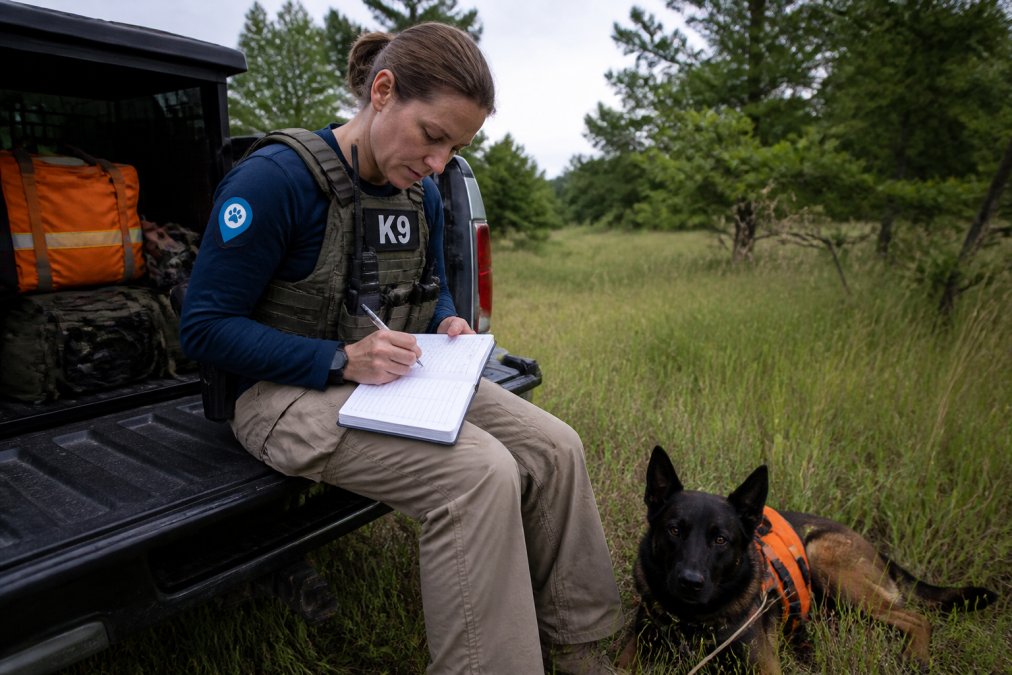
A SAR K9 training log template is only useful if it captures the fields an auditor, a certifying body, or a court will actually ask for. Design it around the questions you'll answer later, not what's convenient to write in the field.
The Fields That Hold Up Under Scrutiny
Group your template into four blocks so nothing gets skipped when you're tired and it's getting dark:
- Session header, date, start and end time, GPS coordinates or a named location, weather, temperature, and terrain type
- Team roster, handler name and certification level, canine name and breed, flanker or support personnel, and the evaluator or witness present
- Problem design, discipline, objective for the day, scent article or target, track or trail age, number of distractors, and area size
- Outcome and follow-up, pass or fail against the objective, handler corrections made, the dog's indication behavior, and the corrective action planned for the next session
Tracking, Trailing, and Scent Discrimination Entries
Tracking, trailing, and scent discrimination each need their own entry structure, because each discipline tests something different and produces different evidence.
- Tracking: record the track layer, age of the track, distance, and number of turns
- Trailing: note the starting article, contamination level, and whether the trail was aged or fresh
- Scent discrimination: log the number of distractors, the target scent, and the dog's indication behavior
A Worked Entry Example
A trailing entry that survives review reads something like this: *March 14, 06:40 start, 07:15 end. Riverside Park, north lot. Overcast, 48°F, wet grass and gravel. Handler J. Reyes (SARTECH II, trailing certified), canine Kessa, flanker M. Doyle. Objective: aged trail, 45 minutes, two road crossings. Start article: leather glove, worn 20 minutes by subject. Trail aged 45 minutes before run.
Why the Witness Field Matters Most
A self-reported training log is one person's word; a log with a named witness or evaluator is corroborated. When a certification is challenged, that difference is often the whole case. Make the witness field required, not optional, and treat entries without one as lower-weight evidence.
Scenario-Based Training Exercises and Mock Certification
Scenario-based training exercises simulate the conditions of a real deployment, and mock certification runs the team through the full evaluation format before the real test.
Build scenarios that stress the weak points:
- Set a search area with realistic terrain and distractions
- Brief the hider or suspect role and log the placement
- Run the canine team through the full search sequence
- Record the outcome, timing, and any handler corrections
- Debrief and log the corrective action taken
Court-Ready K9 Training Reports and Deployment Records
Court-ready K9 training reports are records a handler or supervisor can produce and defend under questioning, with enough detail that the opposing side cannot argue the documentation was created after the fact. Deployment records carry the same burden: capture the call, the assignment, the search area, the outcome, and the handler's contemporaneous notes. Contemporaneous is the operative word, a record written the same day, with a timestamp, is far harder to challenge than one reconstructed a month later.
- Who was on the team, and were they qualified that day?
- What was the canine's certification status at deployment?
- What did the dog do, and how was that recorded?
- Who witnessed or reviewed the record?
Post-Certification Maintenance and Recertification Cycles
Post-certification maintenance is the work that keeps a certified canine team deployable between evaluations, and recertification cycles are the deadlines that work has to hit.
Why Maintenance Requirements Don't Line Up
There is no single national maintenance schedule for SAR canine teams. Requirements come from several directions at once, and they rarely agree:
- National certifying bodies set their own recertification intervals and minimum training hours per discipline
- State or regional authorities may layer additional requirements on teams that respond under their authority
- Local agencies can require their own proficiency checks before a team deploys on their incidents
- Discipline-specific standards for trailing, area search, HRD, and avalanche work each carry their own maintenance expectations
Building a Maintenance Calendar That Actually Holds
The practical answer is to configure your logging tool around the strictest requirement you operate under, then track every cycle against that baseline. Satisfy the toughest standard and you satisfy the rest.
- Certification expiration date for every discipline the team holds
- Training hours logged against the minimum for each cycle
- Proficiency checks completed and who evaluated them
- Next required evaluation with a lead time buffer before the deadline
The Maintenance Log Is the Recertification Application
Here is the angle most teams miss: the training log you keep between certifications is the evidence you submit at recertification. Thin maintenance records make the review harder than it needs to be, because you're reconstructing a year of work from memory instead of exporting it. Handlers who log consistently walk into recertification with documentation already assembled; those who log only around test time spend the weeks before chasing signatures and rebuilding dates.
When a Certification Lapses
A lapse is not always the end of the team. Most certifying bodies allow a handler to re-test, and some allow a grace period if the team can show continuous training. What they will not accept is a gap in the record. Show the team trained through the lapse and re-testing is usually a scheduling problem; fail to, and the team may be treated as new, starting from the beginning of the cycle.
Frequently Asked Questions
What documentation is required for SAR K9 certification?
Most SAR certifying bodies require training logs, deployment records, handler qualifications, and canine proficiency test results. SARTECH standards typically ask for scent discrimination evidence, search area documentation, and validated hider or suspect scenarios. Wilderness first aid and CPR certification for the handler usually must be current. Keeping all of this in one place makes recertification and auditing far easier than pulling from scattered paper logs.
How do you maintain defensible records for K9 unit deployments?
Defensible records need three things: they must be created at or near the time of the event, they must be consistent across every handler on the team, and they must be retrievable without gaps. Court-ready K9 training reports should include date, location, conditions, scent type, search area, outcome, and handler signature. Cloud based K9 record keeping helps because timestamps and audit trails are built in, so nothing looks reconstructed after the fact.
Why is centralized certification tracking critical for SAR teams?
When certification data lives in individual binders or spreadsheets, supervisors cannot see team-wide readiness at a glance. Centralized K9 certification tracking shows which canine teams are current, which are due for recertification, and where training gaps exist. It also supports compliance and auditing when an agency or certifying body requests records. For multi-handler teams, centralization is the difference between proactive management and last-minute scrambling.
How often should SAR K9 teams update their certification logs?
Best practice is to log every training session and deployment within 24 hours while details are fresh. Proficiency tests and mock certification results should be entered the same day. Recertification cycles vary by certifying body, but most SAR K9 teams recertify annually or every two years. Regular logging keeps performance data accurate and makes the recertification packet a simple export rather than a reconstruction project.
Certification tracking for SAR K9 teams comes down to one habit: capture the record at the moment it happens, in a format you can defend later. Trakker was built for exactly that, with comprehensive tracking for training, deployments, and certifications in one place, court-ready report generation, and ANSI 076 standards built in for visibility. Get started with Trakker and keep every certification, deployment, and training entry audit-ready from day one.